Tracing a Legacy: Martha Graham’s Century-Long Journey to Jacob’s Pillow
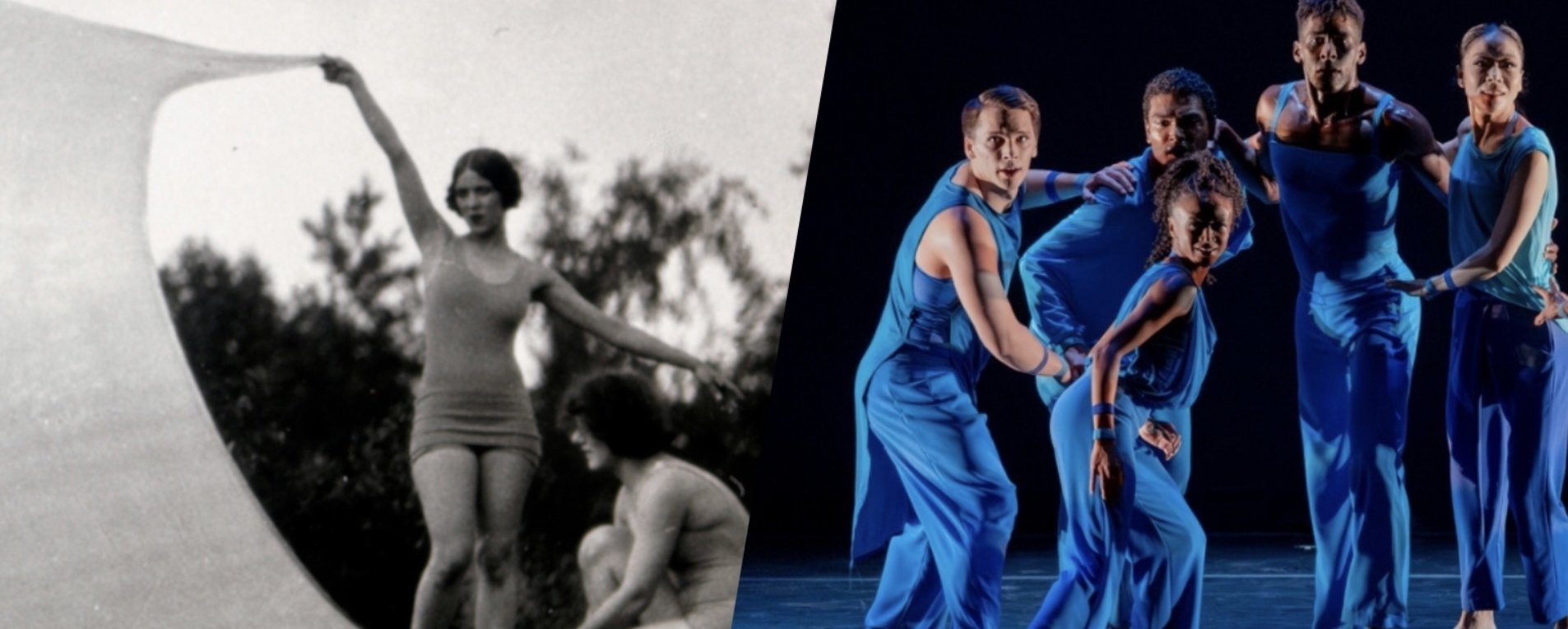
Left: Denishawn dancers (including Martha Graham at left) in Doris Humphrey and Ruth St. Denis’ Soaring at Mariarden in Peterborough, NH, ca 1922. Right: Martha Graham Dance Company; photo by Luque Photography.
New York Times dance critic Anna Kisselgoff wrote in 1984 that “Martha Graham’s name remains a virtual synonym for modern dance.” Over forty years later, that sentiment rings true. A lauded artistic pioneer of the 20th century and named among the female “Icons of the Century” by People magazine, Martha Graham created genre-defining works and a codified movement language that is nearly as pervasive as ballet in its scope and influence. Since it was established in 1926, Martha Graham Dance Company continues to expand the scope of dance, presenting groundbreaking works from Graham’s repertoire of 181 ballets alongside pieces by leading choreographers of today.
In Festival 2026, Martha Graham Dance Company will return to the Berkshires in its 100-year anniversary season, with an engagement that anchors Jacob’s Pillow’s celebration of women in dance, to commemorate the 250th Anniversary of the signing of the Declaration of Independence. The Company’s return to the Pillow, at such a pivotal moment in time, highlights the intertwining legacies of Jacob’s Pillow and Martha Graham.
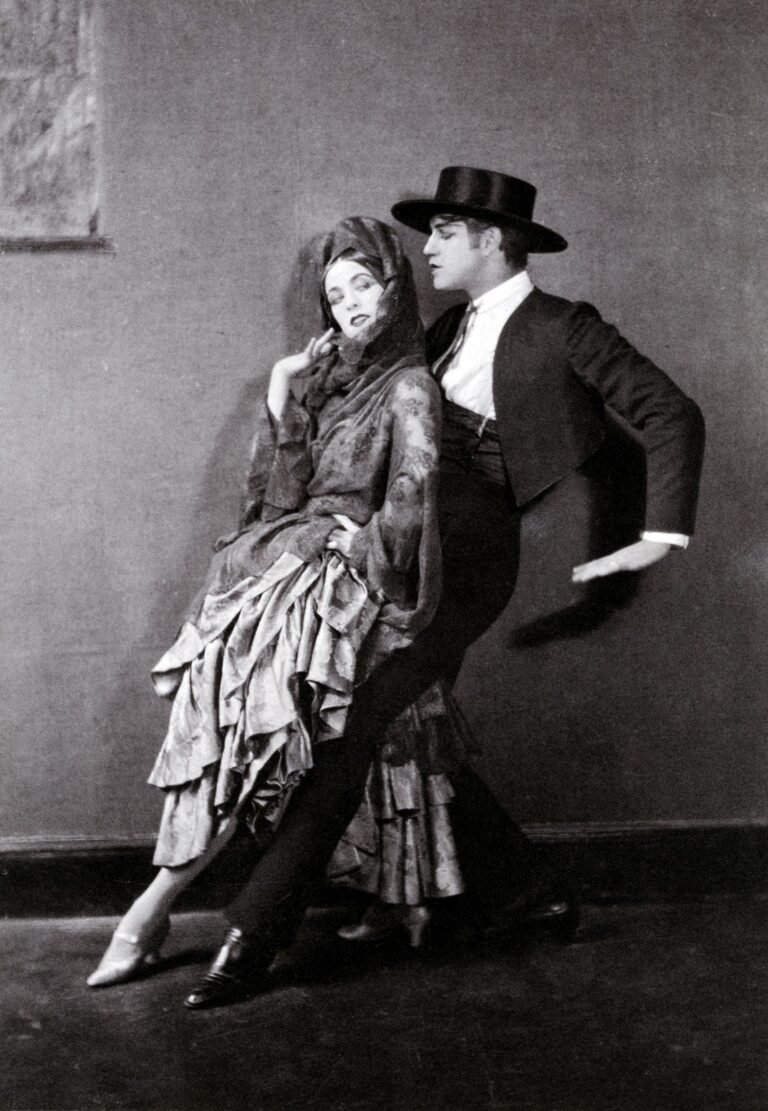
The first touchstone between Jacob’s Pillow and Martha Graham dates back to the early twentieth century, at the start of Graham’s professional career. In 1916, Graham enrolled in the Denishawn School in Los Angeles, a school of dance created by the founder of Jacob’s Pillow, Ted Shawn, and his wife and artistic partner, Ruth St. Denis. Shawn nurtured Graham’s talents as a performer, and from 1921-1923, Graham toured extensively throughout the United States, performing with the Denishawn Company in leading roles.
The artist in me was born in Denishawn.
– Martha Graham
In 1926, Graham founded her own company, creating works inspired by sources such as modern painting, American pioneers, and Greek mythology. Several of her most important roles portrayed great women of history and mythology, centered in the time’s broader currents of political theater and social activism.
Graham’s journey did not lead back to the Pillow until 1956, when she observed classes and attended a performance by San Francisco Ballet. Of this visit, Shawn wrote “Martha loved our theater, and gave me real hope that someday she will grace the stage of the Ted Shawn Theatre.”
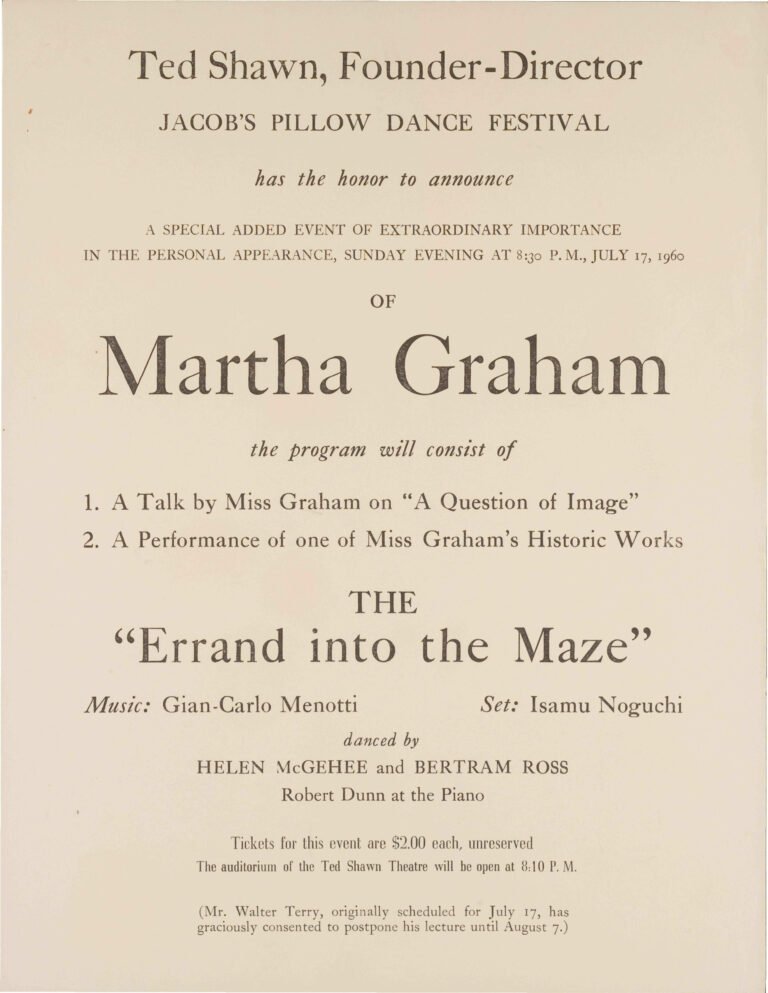
This dream would be fulfilled in 1960, when Graham gave a talk on “A Question of Image,” preceding the performance of one of her seminal works, Errand into the Maze by Helen McGehee and Bertram Ross. Errand into the Maze is one of many of Graham’s Greek-inspired works with sets by Isamu Noguchi. The program of the lecture-performance was billed as a “special added event of extraordinary importance.”
Though this marked Graham’s first appearance at the Pillow, Martha Graham Dance Company did not make its official Pillow debut until 1984, performing Graham’s historic works Cave of the Heart, Errand into the Maze, and Diversion of Angels. Following the performance each night, Graham joined the dancers on stage for a bow.
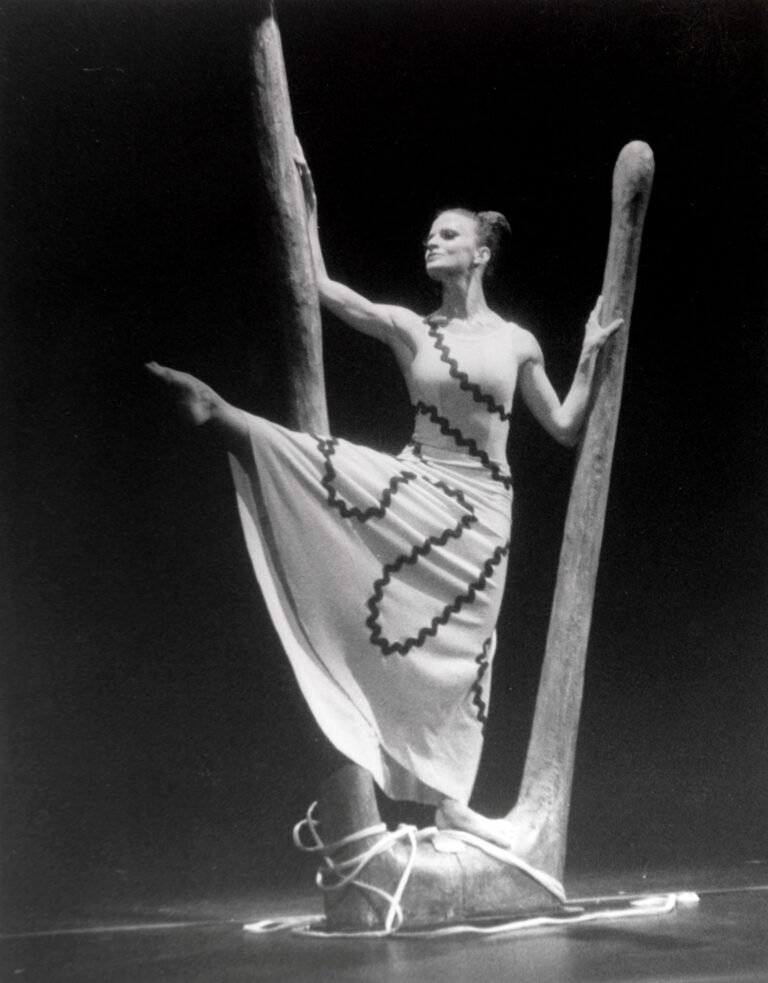
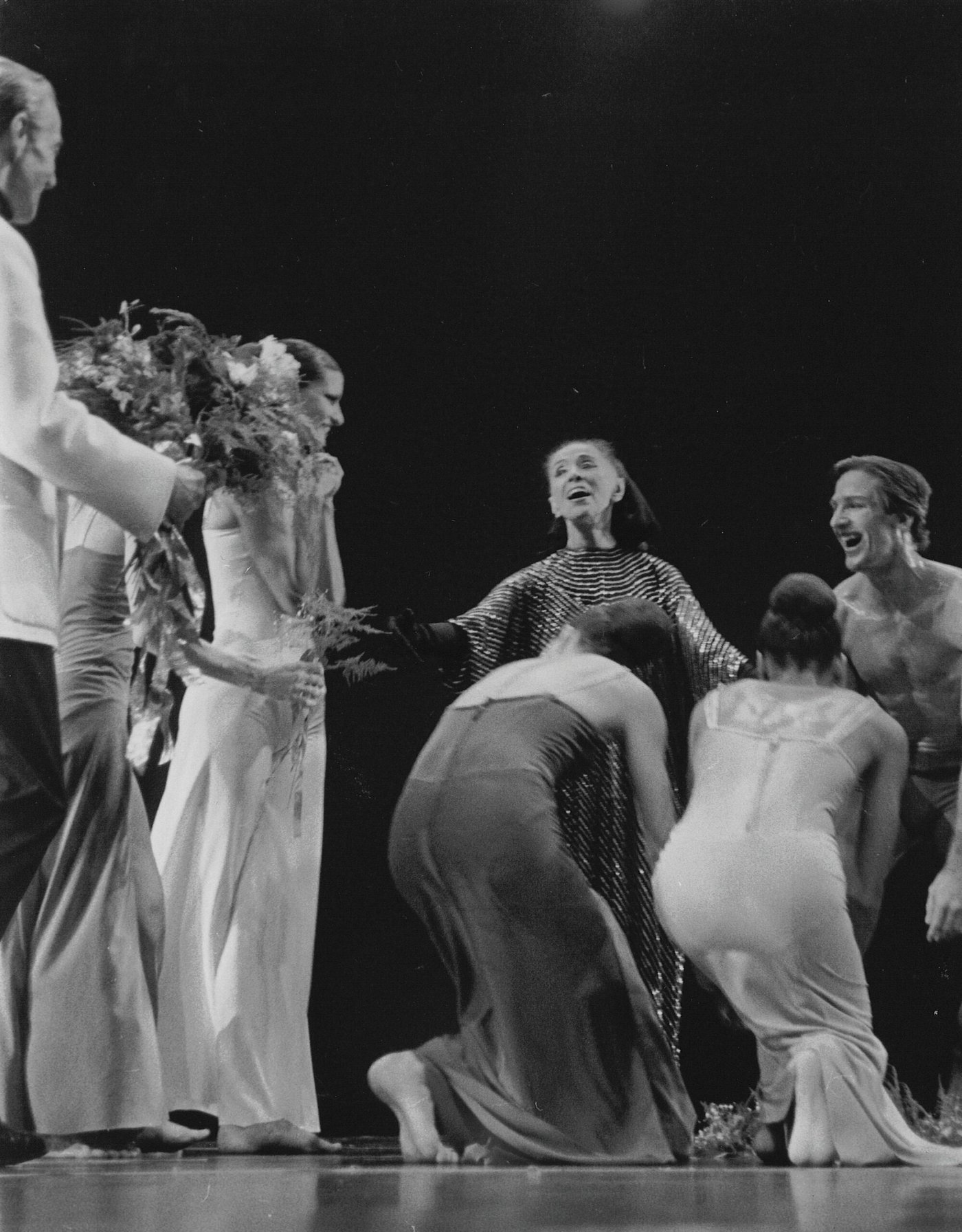
Martha Graham Dance Company has returned to perform at several Festivals throughout the years, appearing most recently in Festival 2023. Calling back to the company’s historic debut, the program included Cave of the Heart and Errand Into the Maze, alongside Cave, a new work commissioned by the company by Hofesh Shechter.
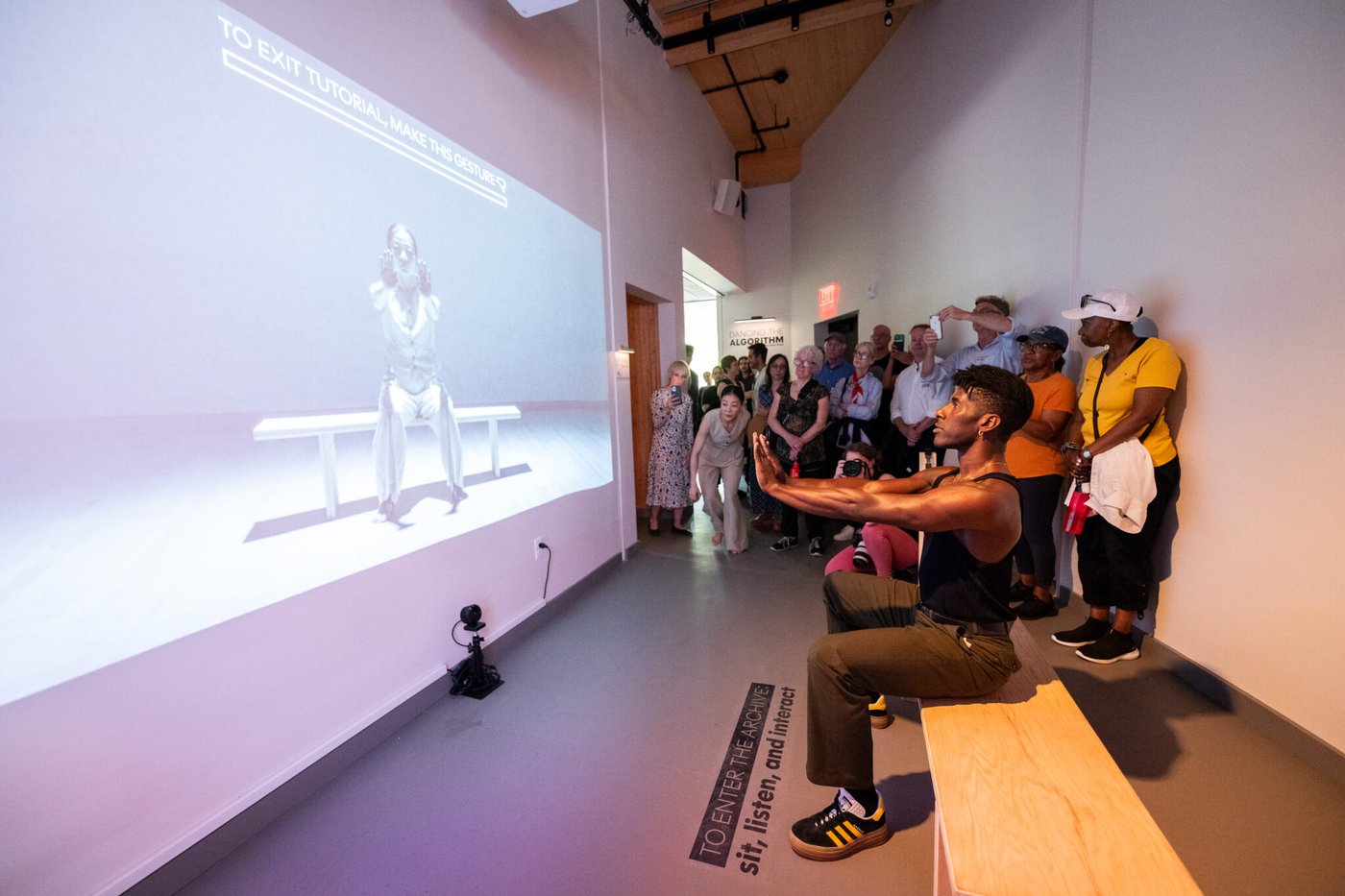
In Festival 2025, Graham’s iconic 1930 solo work, Lamentation, was brought into the interactive digital world in the Dancing the Algorithm exhibit in the Doris Duke Theatre. Lamentation: Dancing the Archive, conceived by Xin Ying of the Martha Graham Dance Company and co-created by Katherine Helen Fisher, Alan Winslow, and Kate Ladenheim, allowed audiences to step into the work with their own gestures and movement, fostering closeness to Graham’s early modernist distillation of raw angst and building embodied bridges from past to present.
Next summer, during its centennial celebration, Martha Graham Dance Company will return to the Pillow in an engagement that spans historic venues across the Berkshires. In Festival 2026, the Company will perform En Masse, co-commissioned by Jacob’s Pillow and Boston Symphony Orchestra’s Tanglewood, where the company will perform for one night only.
“The legacies of Jacob’s Pillow, Tanglewood, and the Martha Graham Dance Company have intersected at crucial junctures for decades.”
– Janet Eilber, Artistic Director of the Martha Graham Dance Company
Alongside the Company’s performances, Jacob’s Pillow will host a summer-long exhibition in Blake’s Barn that explores Martha Graham’s artistic and political voice, curated by former Graham dancer and scholar Oliver Tobin. The exhibition will focus on Graham’s creations specifically for women, positioned within the social and political currents of her time. Together the performances and exhibition highlight Graham as an outspoken, revolutionary artist who explored the intersections of art and politics.
The Archives at Jacob’s Pillow are filled with revolutionary female choreographers and artists, and several of these artists have created work that investigate the role of women and femininity in society. On Jacob’s Pillow Dance Interactive, a playlist titled Strong Women celebrates the work of these transformational artists, including Martha Graham Dance Company’s Chronicle.
Graham described the final section Chronicle as a call for a “brave new world” at its premiere in 1936, and in this excerpt, we see a single dancer in white rising triumphantly above the stage.
Another work highlighted in the playlist is She’s Auspicious by celebrated Bharatanatyam dancer and choreographer Mythili Prakash, in which Prakash explores the tension between the celebration of the Goddess and the treatment of women in society.
Scholars at Jacob’s Pillow have sought out these women choreographers in their research, highlighting their contributions to the dance landscape and analyzing work created in a feminist lens. On Jacob’s Pillow Dance Interactive, Pillow Scholar-in-Residence Maura Keefe has curated a collection of essays that center women in dance. In the most recently published essay of the collection, 2023–24 Faculty Research Fellow and contemporary dance artist Sarah Zehnder explored the woman-centered work of Liz Lerman, Ananya Chatterjea, and Kate Weare in the Pillow’s Archives, all of whom “in their own ways, weave their artistic vision with the aesthetic and political in powerful signification.”
“They not only touch upon the institutionalized oppression of women and commitment to resist, but also offer hope, joy, and both collective and individual identity, while redefining notions of beauty and empowerment,” writes Zehnder.
Anchored by performances by Martha Graham Dance Company, Festival 2026 will celebrate groundbreaking women who have shaped, and continue to shape, dance in the United States to commemorate the 250th anniversary of the nation’s founding.

Inside the Faculty Research Fellowship with Rain Ross

Inside the Faculty Research Fellowship with Careitha Davis