The History of Jacob's Pillow
Once a hard-scrabble mountaintop farm, now a home for international dance

An historic place for dance
After Indigenous peoples inhabited this land for generations, this scenic site in the Berkshire Hills of Western Massachusetts was settled by the Carter family as a farm in the late 18th century. In the 19th century, the property served as a stop on the Underground Railroad.
In 1931, the land was purchased by dancer and choreographer Ted Shawn. This site was to serve as a retreat for himself and his dancers, and so began the story of Jacob’s Pillow Dance Festival, the longest-running international dance festival in the country. In 2003, Jacob’s Pillow was designated a National Historic Landmark by the United States government, the first and only dance site to receive this honor.
Founded on change, built to grow
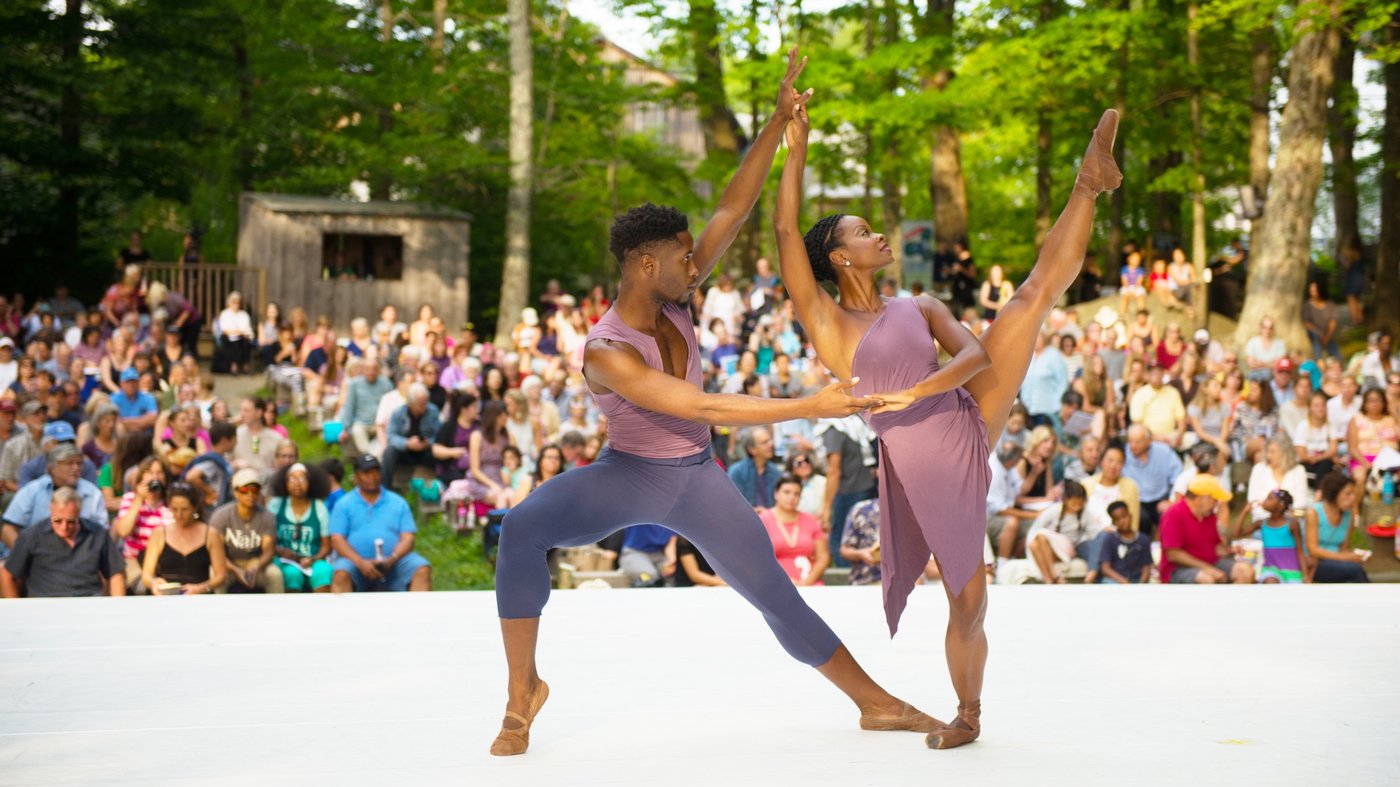
Jacob’s Pillow today is alive with year-round programming, welcoming artists and audiences into a place that is both deeply rooted and always evolving. Our sense of community is marked by simple traditions—like the ringing of the bell before a performance—that connect us to our past, even as we come together to imagine the future of dance.
Each chapter has demanded reinvention and imagination from generations of leaders and staff. Executive & Artistic Director Pamela Tatge—who in her tenure at Jacob’s Pillow since 2016 has overseen the opening of the new Doris Duke Theatre, the renovation of the Ted Shawn Theatre, the expansion of the Archives, and the introduction of year-round programming including the Pillow Lab and community engagement programs—carries on the ideals and commitments of former Pillow directors Ella Baff (1998-2016), who engineered an unprecedented period of institutional growth expanding the Pillow’s international reputation and growing its audience; Sali Ann Kriegsman (1995-1997), who launched the Audience Engagement Program; Samuel A. Miller (1990-1994), who spearheaded a sorely needed renovation and enlargement of the Ted Shawn Theatre and the installation of Blake’s Barn; Liz Thompson (1980-1990), who began the popular Inside/Out presentations and initiated open access to the grounds and studios, and the construction of the Doris Duke Theatre; and Norman Walker (1975-1979), who revamped and upgraded the Pillow’s educational and presentational standards in the years after Ted Shawn’s passing in 1972.
This tradition of resilience goes back to the beginning. In the 1930s, Ted Shawn arrived with a dream of redefining dance in America, turning a mountaintop farm into a progressive experiment in artistry and survival. Against the backdrop of economic depression and later war, audiences still climbed the hill—sometimes on horseback—to see boundary-pushing performances in a serene rural setting unlike any other. That spirit of welcoming, creativity, and curiosity about our evolving role and responsibility remains at the heart of Jacob’s Pillow.
Why is it called Jacob's Pillow?
To settlers in the late 18th century, the switchbacks on what is now Route 20 were reminiscent of the ladder to heaven depicted in the Bible, and so they named the road Jacob’s Ladder. Finding this cushion shaped rock on their farmland more than two centuries ago, the Carter family furthered the allusion by naming their homestead “Jacob’s Pillow.” Ted Shawn kept the name.
A Timeline of Firsts: 1933 to Today
1933
Jacob’s Pillow presents its initial performance on July 14, becoming the first dance festival established in America that continues to this day.
1933-39
Most of the works created by Ted Shawn for his company of Men Dancers are premiered at Jacob’s Pillow.
1942
Asadata Dafora, the first artist to perform African dance on the concert stage, is part of the inaugural season of the Ted Shawn Theatre.
1943
Joseph Pilates demonstrates his body conditioning system onstage and trains Pillow students in the technique that remains a global phenomenon.
1950
Shawn invites Jack Mitchell to take his first dance photos at Jacob’s Pillow, launching the career of this pre-eminent performing arts photographer.
1954
The work of 19th century choreographer August Bournonville is seen in the U.S. for the first time when Danish ballerina Inge Sand appears at the Pillow.
1956
Merce Cunningham & Company give the first performance of Nocturnes at the Pillow, with décor and costumes by Robert Rauschenberg.
1960
John Butler’s popular duet, Portrait of Billie, premieres at the Pillow, performed by the choreographer himself and Carmen de Lavallade.
1961
Alvin Ailey’s Revelations is presented for the first time in its present form at Jacob’s Pillow, including the premiere of the solo “I Wanna Be Ready.”
1962
Balasaraswati, one of India’s most famous and revered dancers, makes her first American appearance at the Pillow.
1964
Twyla Tharp makes her professional debut, performing with the Paul Taylor Dance Company.
1970
The first professional appearances by Arthur Mitchell’s Dance Theatre of Harlem take place at Jacob’s Pillow.
1973
Dame Margot Fonteyn makes her Jacob’s Pillow debut in the first performance of a commissioned solo, Peter Darrell’s In Nightly Revels.
1983
Liz Thompson initiates a new outdoor performance series, naming it Inside/Out.
1984
Martha Graham brings her company to the Pillow for the first time, coming full circle nearly 70 years after beginning her dance studies with Ted Shawn.
1985
Former New York City Ballet star Nikolaj Hübbe (who later became the director of the Royal Danish Ballet) gives his first American performances here as a Pillow student.
1994
A film collaboration between choreographer Mark Morris and cellist Yo-Yo Ma, Falling Down Stairs, is created at the Pillow.
1995
Mikhail Baryshnikov premieres works by Mark Morris and Dana Reitz in his first appearance at the Pillow.
1999
The controversial Chineseopera The Peony Pavilion makes its first U.S. stop at the Pillow, where the cast assembles for several weeks to rehearse prior to its Lincoln Center premiere.
2003
Jacob’s Pillow is named a National Historic Landmark by the federal government for its importance in American culture and history, becoming the first dance institution to be so honored.
2007
The 75th Anniversary Season launches the first Jacob’s Pillow Dance Award. The Pillow becomes the first cultural institution on the Upper Housatonic Valley’s African American Heritage Trail.
2011
Jacob’s Pillow becomes the first dance-presenting organization to be awarded the National Medal of Arts, presented by President Barack Obama in a White House ceremony.
2015
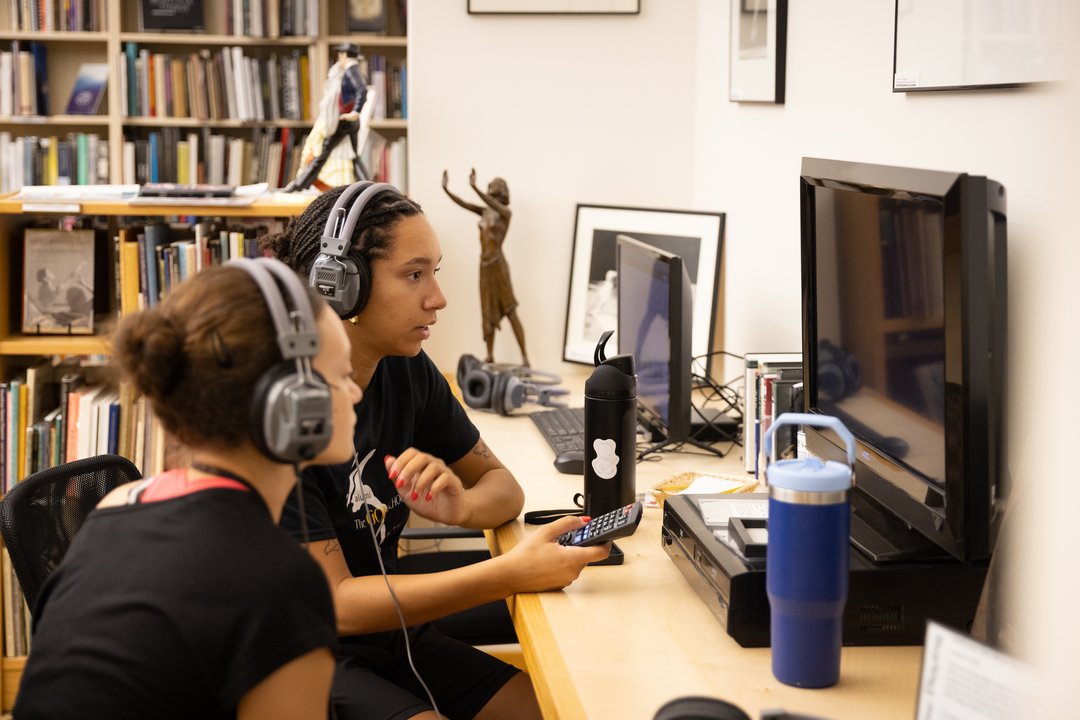
A major expansion to Blake’s Barn provides more space for The Archives and the new Norton Owen Reading Room, expanded once again in 2021.
2018
The Perles Family Studio welcomes its first classes as the new home to The School at Jacob’s Pillow, becoming the Pillow’s first new dance space in over 25 years.
2020
For the first time in its history, the Pillow cancels its onsite Festival because of the COVID-19 pandemic, instead presenting a broad spectrum of online events. On November 17, the Doris Duke Theatre is completely destroyed by fire.
2022
Following a ‘hybrid’ onsite and online Festival in 2021, the Pillow opens the newly-renovated Ted Shawn Theatre for its 90th Anniversary Season—a return to indoor performances after a three-year hiatus.
2025
Five years after the loss of the original Doris Duke Theatre, Jacob’s Pillow opens its reimagined namesake, built with increased technological capacity to serve as a living lab for the future of dance.
"Having made yet again the pilgrimage to this most charismatic and spiritual heart of dance in America and having yet again made my contribution to its vast history, I am humbled and moved."
—Bill T. Jones, Co-Founder and Artistic Director of the Bill T. Jones/Arnie Zane Company
Past and Present: Conversations and Representation
The historic videos and photographs from the early 20th century that Jacob’s Pillow presents and engages with may include images of early modern dance artists borrowing costumes, vocabulary, exoticized imagery, and movements from cultures other than their own, including Indigenous, South Asian, East Asian, and other non-European cultures. Among these dance artists was Ted Shawn, founder of Jacob’s Pillow Dance Festival.
Modern dance developed in the U.S. in the late 19th and early 20th centuries, a time that was both a period of exploration of Indigenous, Asian, and non-European cultures by U.S. artists unfamiliar with these cultures and a time of exclusion and hostility toward efforts to welcome people from those cultures into the U.S. For example, the Chinese Exclusion Act of 1882 was the first U.S. federal law to restrict immigration based on race and was eventually renewed to limit immigration by people from other parts of Asia.
Within this context, and other exclusionary practices, many early American modern dance artists reflected the larger U.S. cultural norms of their day. Shawn was known both for celebrating and othering non-Western forms by borrowing from these cultures to create his own works.
As an organization that values dialogue across past, present, and future generations, we are working to understand this history and grapple with its implications today. The following resources provide insights and links to how contemporary artists and curators at Jacob’s Pillow are in active conversation with, and considering approaches to reconciliation with, these historical legacies.
Click the bold titles to learn more.
Pillow Blog Post:
Phil Chan: Sitting with Discomfort
Pillow Blog Post
Interweaving Indigenous Principles: Visual Art and Landscape Design in the New Doris Duke Theatre
PillowVoices Podcast
The Complexities of Indian Dance at the Pillow
PillowVoices Podcast
Fluid Roots and Resistance in Contemporary Indian Dance
PillowVoices Podcast
Native Contemporary Dance: No Longer in Sepia Tones
PillowVoices Podcast
A Study of José Limón: Artist and Immigrant
PillowVoices Podcast
Beyond the First 50 Years of Hip Hop with Michele Byrd-McPhee
PillowVoices Podcast
Representation, Identity, Diaspora, Through the Lens of Mimulus Dance Company
PillowVoices Podcast
Dance and Belonging with Crystal U. Davis
Multimedia Essay
Welcoming the World
Multimedia Essay
Fantasy Meets Reality: The Far East Tour, 1925-26
Multimedia Essay
Black Dancers in the Berkshires
Video Playlist
Asian and Asian American
Video Playlist
Black Voices
Video Playlist
Hispanic and Latinx Artists
Video Playlist
Indigenous Dance of the Americas